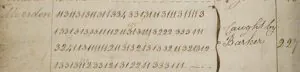
Picture courtesy of Mick Pope. The close up scorecard of Tom Marsden’s innings of 227.
SHEFFIELD’S GLORY AND PRIDE
‘Then Marsden went in, in his glory and pride,
and the arts of the Nottingham Players defied.
Oh! Marsden at Cricket is nature’s perfection,
for hitting the Ball in any direction’.
In a variation on the theme of a Yorkshire versus Nottinghamshire Bygones piece, Mick Pope pays a bicentennial tribute to Tom Marsden’s innings of 227 at Darnall Cricket Ground in July 1826.
Long before the fierce Roses rivalry between Yorkshire and Lancashire gripped players and spectators alike, there was another more ancient contest in the pre-county cricket era of the early 19th century.
Teams representing Sheffield and Nottingham challenged each other, home and away, as far back as 1771 and 1772, and twice again on Nottinghamshire soil (Mansfield and Worksop) in 1800.
During the 1820s, though, the encounter became a far more prevalent fixture, with the two sides meeting on nine occasions between 1822 and 1829 in those pre-railway times when travel was by coach and horses.
Rapid developments
There were several reasons for the increased frequency of these matches during that particular decade, and a number of significant developments that meant the meetings between industrial Sheffield and the lace town of Nottingham became far more meaningful and competitive.
Firstly, Yorkshire secured its first purpose-built cricket ground when in 1822 local businessman and cricket lover George Steer opened his new venue at Manor Hill, Darnall on the outskirts of Sheffield.
Fifteen of Sheffield hosted a Nottingham XI there in late August.
The Nottingham Old Club triumphed easily by 10 wickets, whilst the collapse of a grandstand led to a number of injured spectators. Undaunted, Steer, with the assistance of his son-in-law William Henry Woolhouse, set about developing an expanded and improved new ground at Darnall, which opened in August 1824.
Secondly, the Wednesday Cricket Club – believed to have been formed in 1820 – brought together the best Sheffield cricketers, and the new Darnall ground offered the ideal place to play and to practice.
Thirdly, those same players recognised they needed to improve the general standard of their skills in all departments, and so professional coaches (namely John Sparks, William Fennex and George Brown) from the South of England were engaged.
The final piece of the jigsaw was to uncover a Sheffield cricketer of note, and in 1824 Tom Marsden announced his intentions to fulfil that role.
The ‘Brocco lad’
The son of a Sheffield bricklayer, Thomas Marsden was born in 1803.
As a boy, he played with a wooden ball and a homemade bat with anyone who’d join him near his Jericho home on the red soil patch of land known in Sheffield as the Brocco.
There he developed his skills as a fast underhand left-arm bowler and a powerful left-handed batter, and he became known as the ‘Brocco lad’.
As a man, he stood 5ft 8ins and weighed 12 stones.
Picked for Sheffield against Bingham in August 1824, Marsden top-scored for his side and took 11 match wickets, but the performance that won him lasting fame and celebrity came in late July 1826.

Picture courtesy of of Mick Pope. Darnall Cricket Ground.
‘This extraordinary match…’
In the spring of 1826, WH Woolhouse formally took over the running of the ‘Darnall New Ground’ from his father-in-law. In the Sheffield Independent of 22 July, he announced that a three-day fixture (24 to 26 July) between a combined Sheffield (six players) and Leicester (five players) team and eleven of Nottingham would be played there for the significant purse of 200 sovereigns.
Interest in the match was considerable, and across the three days it was estimated that around 30,000 spectators purchased what was known locally as a ‘Darnall note’ (a metal coin token) by paying either sixpence or a shilling to gain admission through the ‘Old Ground to the Tents’.
Fine weather across all three days of the fixture helped to swell the crowd numbers, as of course did Marsden’s deeds with the bat on days two and three.
Day 1 – Monday 24 July
The start time of the match, originally fixed for 10.30am, was considerably delayed due to the late arrival of the Nottingham umpire.
Play finally got going in early afternoon, and the combined Sheffield and Leicester side, referred to in one Sheffield newspaper report as ‘the Union’, inserted the visitors.
The first eight overs – with Marsden opening the bowling – yielded just six runs, and the Nottingham batters struggled throughout their innings to get going and were dismissed for 101. Marsden’s four wickets cost 51 runs from 28 four-ball overs, as was the custom at the time.
Day 2 – Tuesday 25 July
The stumps were pitched at 11.30am on the second day, and against the slow, peculiar under-arm bowling of William Clarke and the faster stuff of Thomas Barker, two early wickets fell, bringing Marsden to the crease.
The Sheffield Independent scribe described wonderfully what unfolded next.
“When the latter (Marsden) walked up to his post, the buzz of expectation arose from the spectators, and he opened his play with the confident expectations of some, but with the hopes of all.
“He commenced striking in the grandest manner at the very first ball. In 15 minutes, the Nottingham bowlers, seeing their balls – however varied – struck to all parts of the field, apparently at the will of the batsman, took counsel on the ground, and put G.Jervis (sic: Jarvis) in the place of Clarke.
“From this time, Marsden began a course of batting, of which the oldest annals of cricketing afford no parallel whatever.
“The highest state of physical strength, the most perfect confidence, and the greatest practical talent combined to produce such an exhibition of fine play, that we repeat, the oldest records of double wicket afford but one example of anything superior.”
Marsden was later joined in the middle by Leicester player Thomas Gamble, and they shared 205 for the fifth wicket, the latter contributing 61. One particular stroke by Marsden during that second afternoon elicited special mention in the newspaper coverage.
“At the near wicket to the tents, Marsden struck a well-pitched ball which rose somewhat high, clearly out of the ground. It was driven over the highest part of the stone wall on the right of the entrance to the green, at the height of 45 feet from the ground, and alighted at the distance of 130 yards from the place where it was struck.”
That big hit by Marsden formed part of the 13 stanzas rhyme that a local poet wrote after witnessing that tremendous batting display, ‘Then he drove the Ball right over the people, Some thought ’twere going o’er Handsworth Church steeple’.
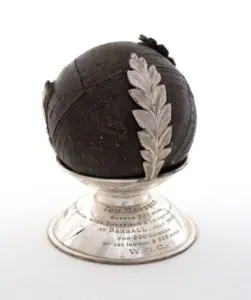
Picture courtesy of Mick Pope. The ball used for the Tom Marsden innings.
Day 3 – Wednesday 26 July
Marsden was not out overnight, and that fact alone added to the size of the crowd on the final day. He did not disappoint, and he batted for a further three-and-a- half-hours, and the Nottingham bowlers had no answers.
“Barker, the Nottingham bowler, at one time so far lost his temper, as to give a full toss, as we thought, at the face of the player instead of his wicket.
“Marsden regarded the ball with a look and manner, which seemed to say – “what will come next?” and struck it down with sufficient power as to cause it to enter the tents.”
Finally, Barker did get his man, though when he caught and bowled Marsden, he had made 227 out of an eventual Sheffield and Leicester total of 379.
The Nottingham second innings floundered, and just before 6pm they were dismissed for 75, beaten by the huge margin of an innings and 203 runs. The Sheffield Independent took great delight in noting: “The truth must be declared that the Nottingham men have been out-played at all points of the game.”
So let’s try and put into context what Marsden achieved at Darnall 200 years ago.
His 227 was only the second double-century in major cricket to that point after William Ward’s 278 versus Norfolk at Lord’s in 1820, made against a far inferior bowling attack than faced by Marsden six years later.
The 22-year-old Sheffield champion scored his runs in a little over eight hours, and his innings was made up of 65 singles, 14 twos, 42 threes and two fours (hits out of the ground).
He scored 51 more runs in that single innings than the 22 of Nottingham managed across their two innings of the match.
All this against bowling that was still under-arm, confronted by two of the finest exponents of that style in Clarke and Barker, although the march towards the round-arm style was gathering momentum.
Whilst some preparation would have taken place, the pitch would still have been rough, uneven in parts, with the grass cropped by sheep or scythe – or a combination of both. The invention of the lawnmower was still four years away!
Finally, think of the inferior bats used at the time to compile such a score compared to the modern equivalent. Simply remarkable.
Foundations laid, and an enduring Sheffield legacy
Tom Marsden’s fame, like that of the Darnall cricket ground and some of those involved with the enterprise, proved relatively short-lived.
The body of George Steer, the founder of the Darnall grounds, was recovered from the Sheffield canal in November 1827. WH Woolhouse soon switched his allegiances to the new cricket ground at Hyde Park, nearer to the town centre, but bankruptcy followed and he suffered from a spinal condition that led to an early grave in 1837.
By 1832, the Darnall ground had been given up and its grandstand demolished. For a time, wheat was grown there. Then, in 1859, the majority of that briefly famed turf became the site of Darnall Cemetery.
Marsden’s best deeds were largely behind him by the age of 25, not helped perhaps by him becoming a publican. He died of consumption in February 1843. Twenty years later, the Yorkshire County Cricket Club was formed at the Adelphi Hotel in Sheffield, and we know what came next.
Two hundred years on from ‘Marsden’s Match’, another Sheffield-born cricketer, Joe Root, is now England’s leading Test run-scorer and sits behind only Sachin Tendulkar in the all-time Test runs table.
In so, doing Joe has become the modern equivalent of Sheffield’s glory and pride.
NB. If the match was played for 200 gold sovereigns in today’s money, it would be the equivalent of approximately £110,000.