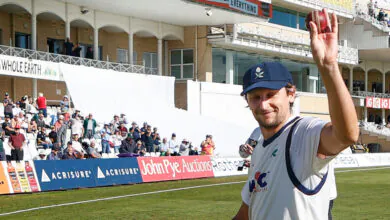

Picture courtesy of Mick Pope. Ted Peate claimed a fabulous 8-5 in a Yorkshire win over Surrey in 1883.
Yorkshire’s county match against Surrey in 1883 was the occasion of Ted Peate’s best ever figures of eight wickets for five runs – and, at the time, the best ever figures in the county.
It was a period when Yorkshire bowlers feasted on Surrey batsmen.
According to Rev RS Holmes, the previous Yorkshire record was Billy Bates’ 8-21 against Surrey in 1879, while Tom Emmett had narrowly failed to equal it with 8-22 in 1881.
Peate himself had already taken eight wickets in an innings against Surrey, with 8-30 in 1881. So, the men from the south must have been heartily sick of the sight of Yorkshire bowlers in this period!
The match in 1883, played at Holbeck, was a rare visit to Leeds by the county side – Headingley was just a twinkle in the imagination at the time – and The Yorkshire Post referred to the internal politics by starting its report, “A county match at Leeds at last!
“After many unsuccessful attempts to get the metropolis of the West Riding recognised as a cricketing centre by the powers that be, untiring perseverance in that direction has at last been crowned with that success, which has been its rightful due for a number of years past.”
So it was that Lord Hawke led Yorkshire out on Monday July 23.
It was a rare appearance for Yorkshire by Hawke. To be precise, one of nine that season followed by only four in 1884 and none at all in 1885 as he devoted more time to leading Cambridge University.
The ground was packed by the time George Ullyett and Lewis Hall took to the field.
Conditions were tricky, and Yorkshire scored 115, thanks mainly to the aforementioned Bates, who hit 55 of them.
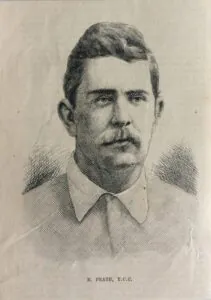
Picture courtesy of Mick Pope. Ted Peate is the first man on the Lord’s honours board thanks to his first-innings 6-85, which helped England win the first ever Test Match against Australia at Lord’s in 1884.
“To top this score was considered an easy task for the Surrey men, but an extraordinary feat with the leather performed by Peate caused the visitors’ wickets to go down with something like a stampede and they were all out for 31,” reported The Yorkshire Post.
In fact, Peate bowled 16 overs, with 11 maidens, in his 8-5 return.
What is remarkable to a modern eye is how low key were the reports of his astonishing figures at the time.
The York Herald, for example, merely said he took eight wickets. The Daily Telegraph said Surrey “could not withstand the bowling of Peate and Bates, the former of whom obtained eight wickets at a cost of five runs, a remarkable performance”.
This owes more to the press style of the time.
Matches were reported wicket by wicket, and individual feats were noted rather than lauded.
Perhaps the London Chronicle was the most sympathetic: “By far the most remarkable bowling performance of the season in first-class matches was accomplished yesterday by Peate on the Holbeck ground in Leeds.
“Of course, the ground was in a condition to materially help the bowlers, heavy rain having fallen on Saturday and Sunday, but for all that Peate deserves immense praise.
“For a considerable time, he has been the most difficult of English bowlers on a slow pitch, and yesterday gave further proof of his exceptional excellence.”
In an interview near the end of his life, Peate told Alfred Pullin, who wrote under the pen name Old Ebor, that his feat was not welcomed by all.

Ian Lockwood is the author of the Ted Peate biography, Ten Drunks and a Parson.
Normally a piece of skilful batting or bowling would be rewarded by a hat being passed round the ground soliciting financial contributions.
However, Peate’s skills had turned a three-day match into a two-day affair, with loss of gate money.
When it was suggested that the traditional contributions be sought, an unidentified man, probably a member of the Holbeck committee, was furious.
“Oh be —- (the blank was inserted in Pullin’s original article). He has ruined our gate. I object to the hat going round.”
Surrey, following on, were 31-5 in their second innings at the end of the first day and, with a Yorkshire victory seeming like a foregone conclusion, the attendance was well down for the second day. Surrey were quickly swept away the next morning to leave Yorkshire victors by an innings and three runs. Peate took 3-25 in the second innings.
It is remarkable to think, the schedule was for the match to run from July 23 to July 25, with the return match at the Oval starting the following day, July 26.
At least Peate’s bowling gave the players a welcome extra day’s rest.
However, Peate did not make the journey down south. No explanation was given, The Yorkshire Post merely stating, “Peate was absent from this game”.
Although two days earlier, Peate had taken eight wickets for five runs, this was a relatively fallow time for Peate.
Against Lancashire, at the start of July, when Yorkshire had dismissed the “old enemy” for a record low score, Peate had failed to take a wicket in either innings. In the return fixture at Bramall Lane 10 days later, Peate was not even in the side.
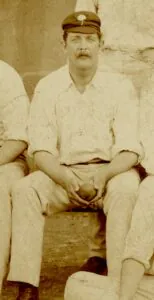
Picture courtesy of Mick Pope. As notable as Peate’s feat against Surrey was, his figures of 8-5 are not even in the top 30 best for the county in first-class cricket. It indicates the rich history of Yorkshire County Cricket Club.
The common legend is that Hawke had a downer on Peate for “insubordination” and his drinking habits.
So, perhaps this was an early sign of his disapproval.
However, Lord Hawke was, according to his biographer James Coldham, “Very much the committee’s servant” at this time, so it seems highly unlikely that he would drop a man who was indisputably the best spin bowler in England at the time.
I think that Peate was suffering the recurrence of an accident in 1882 when he fell from a hansom cab in Leeds and badly sprained his ankle.
It was an injury which was to plague him for the rest of his career and probably led to the shock premature termination of his Yorkshire career less than five years after his glorious day at Holbeck.
Words by Ian Lockwood, the author of Ten Drunks and a Parson, the Ted Peate biography.
Last October, a headstone was unveiled at Yeadon Cemetery for the late Ted Peate, whose grave was previously unmarked. Ian campaigned for the headstone and raised money which went to its cost.